
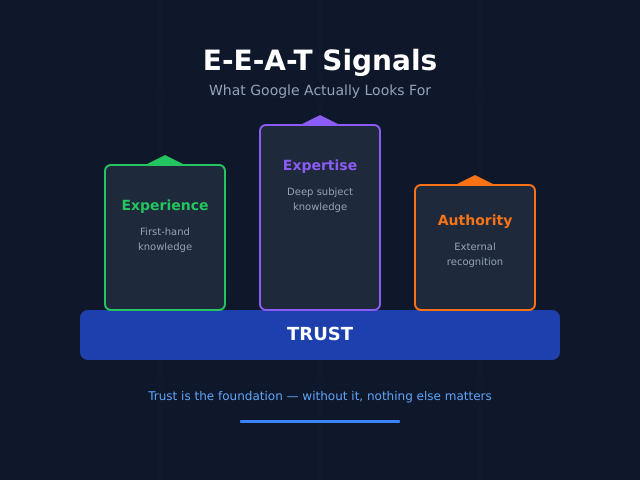
Google has never assigned an “E-E-A-T score” to your pages. There’s no hidden metric, no number between 0 and 100 that determines whether your content passes the trust test. Yet E-E-A-T — Experience, Expertise, Authoritativeness and Trustworthiness — shapes nearly every ranking decision Google makes. The disconnect between what E-E-A-T actually is and what most SEOs think it is costs sites traffic every day.
E-E-A-T is a quality framework, not a ranking factor. Google uses it to train human quality raters who evaluate search results. Those evaluations then inform algorithm updates. In other words, E-E-A-T describes what Google wants its algorithms to reward — and understanding the difference changes how you approach optimization entirely.
What E-E-A-T Actually Is (and Isn’t)
In December 2022, Google added the extra “E” for Experience to the existing E-A-T framework. The Search Quality Rater Guidelines now define four components that quality raters use to evaluate content:
| Component | What It Means | What Raters Look For |
|---|---|---|
| Experience | First-hand involvement with the topic | Personal anecdotes, photos from real use, specific details only someone with direct experience would know |
| Expertise | Knowledge and skill in the subject area | Depth of coverage, technical accuracy, credentials, cited sources |
| Authoritativeness | Recognition as a go-to source | Mentions by other sites, backlinks from respected sources, industry reputation |
| Trustworthiness | Accuracy, transparency, safety | Contact info, clear authorship, factual accuracy, secure site, honest claims |
However, here’s the critical distinction most guides miss: E-E-A-T is not something you “add” to a page like a meta tag. It’s something you demonstrate through a pattern of signals across your entire digital presence. Google’s systems evaluate your domain holistically — not just what’s on a single URL.
Why Trust Is the Most Important Signal
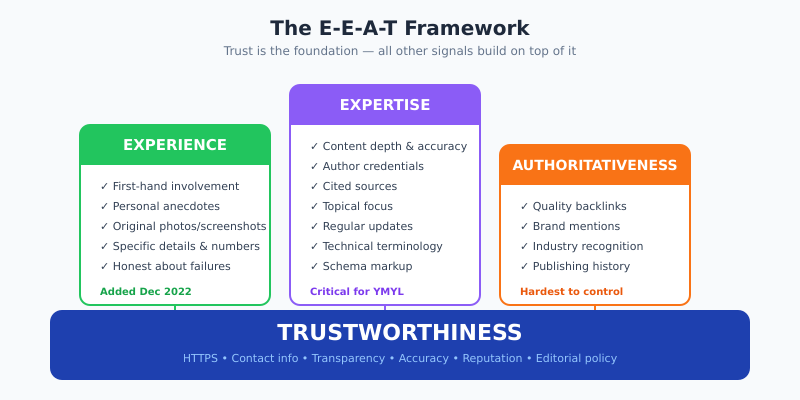
Google’s Quality Rater Guidelines state it explicitly: “Trust is the most important member of the E-E-A-T family because untrustworthy pages have low E-E-A-T no matter how Experienced, Expert, or Authoritative they may seem.”
This hierarchy matters for prioritization. You can have a world-renowned expert writing content on a site with broken HTTPS, hidden contact information and no editorial policy — and that content will still be evaluated as low E-E-A-T. Consequently, trust is where you should start your optimization efforts.
Trust signals fall into two categories:
- On-site trust: HTTPS, clear contact pages, about pages, editorial policies, author bios, privacy policy, transparent business information
- Off-site trust: Positive reputation, absence of negative news, consistent NAP (Name, Address, Phone) across the web, quality backlinks, mentions by trusted sources
Experience: The Newest and Most Misunderstood Signal
The “Experience” component was added because Google recognized that first-hand knowledge has unique value. A product review from someone who actually bought and used the product for six months is fundamentally different from a review compiled from Amazon listings.
In my work optimizing content across different verticals, the sites that demonstrate genuine experience consistently outperform those that don’t — even when the latter have stronger backlink profiles. Experience is hard to fake, and that’s exactly why Google values it.
How to Demonstrate Experience
- Share specific observations — “After testing 12 technical SEO audit tools over three months, I found that…” is far stronger than “Many SEO tools offer audit features.”
- Include original photos and screenshots — stock images signal zero experience. Real screenshots from your own projects signal direct involvement.
- Mention timelines and contexts — “When I migrated a 50,000-page ecommerce site to a new CMS in 2025…” provides verifiable context.
- Acknowledge what didn’t work — sharing failures demonstrates genuine experience more convincingly than listing only successes.
- Use specific numbers from real projects — “Bounce rate dropped from 67% to 41% after implementing lazy loading” beats “Lazy loading improves bounce rates.”
Where Experience Matters Most
Experience carries the most weight for YMYL (Your Money or Your Life) topics and product reviews. For instance:
| Content Type | Experience Importance | Example |
|---|---|---|
| Product reviews | Critical | Hands-on testing with photos and specific observations |
| Medical/health content | Very high | Healthcare professional describing clinical experience |
| Financial advice | Very high | Financial advisor sharing client case studies |
| Travel content | High | Writer who visited the destination with original photography |
| Technical tutorials | High | Developer showing code from actual implementations |
| News reporting | Moderate | Journalist who was present at the event |
Expertise: Depth Over Breadth
Expertise is about demonstrated knowledge — not claimed credentials. A self-taught developer with a portfolio of open-source contributions can demonstrate expertise just as effectively as someone with a computer science degree. Google evaluates expertise through the content itself, not through the letters after your name.
That said, formal credentials matter more in YMYL categories. Medical content should come from licensed healthcare professionals. Financial advice should come from certified financial planners. For these topics, credentials aren’t optional — they’re a prerequisite for ranking.
Signals Google Uses to Evaluate Expertise
- Content depth — comprehensive coverage that goes beyond surface-level explanations
- Technical accuracy — correct use of terminology, up-to-date information, proper citations
- Author bios — relevant background information linked to verifiable credentials
- Topical focus — sites that cover a specific subject area deeply rank better than sites that cover everything superficially
- Content freshness — regularly updated content signals ongoing engagement with the subject
Moreover, expertise is closely tied to topical authority. A site with 50 well-interlinked articles about SEO and keyword research demonstrates more expertise than a site with 5 articles about SEO, 5 about cooking and 5 about travel.
Authoritativeness: What Others Say About You
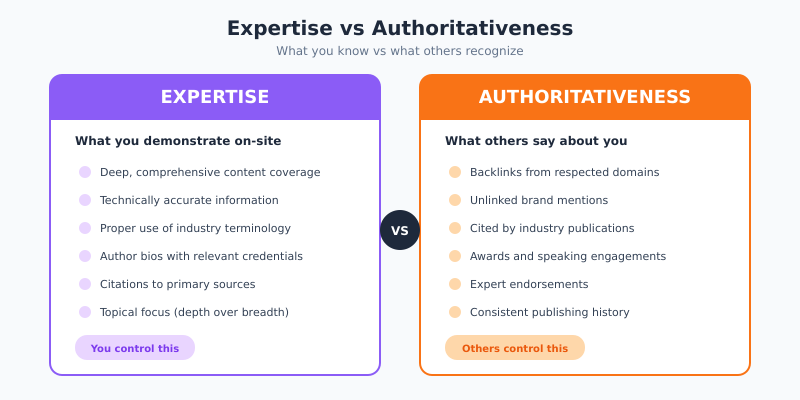
Authoritativeness is the one E-E-A-T component you can’t fully control. It’s determined largely by how other sites, publications and experts reference your work. You can create the best content in the world, but if nobody links to it, cites it or mentions it, your authoritativeness score remains low.
How Google Evaluates Authoritativeness
Quality raters assess authoritativeness by looking at:
- Backlinks from respected sources — links from .edu, .gov, major publications and industry leaders
- Mentions and citations — being referenced (even without links) by authoritative sites
- Awards and recognition — industry awards, speaking engagements, official positions
- Social proof from experts — endorsements or engagement from recognized figures in your field
- Consistent publishing history — years of quality content in a specific niche
Building Authoritativeness (Practical Steps)
This is where most E-E-A-T guides get vague. Here are specific, actionable strategies:
- Publish original research — data studies get cited. Other sites link to unique data they can’t find elsewhere. This is the fastest path to earning editorial links.
- Contribute to industry publications — guest posts on Search Engine Journal, Moz or industry-specific publications build author-level authority.
- Build a consistent author presence — same author photo, consistent bio, linked social profiles across all platforms.
- Get quoted as a source — respond to journalist queries on platforms like HARO, Connectively or Featured.
- Create linkable assets — tools, calculators, comprehensive guides and infographics that other sites want to reference.
For a detailed strategy on earning quality backlinks, see our link building guide.
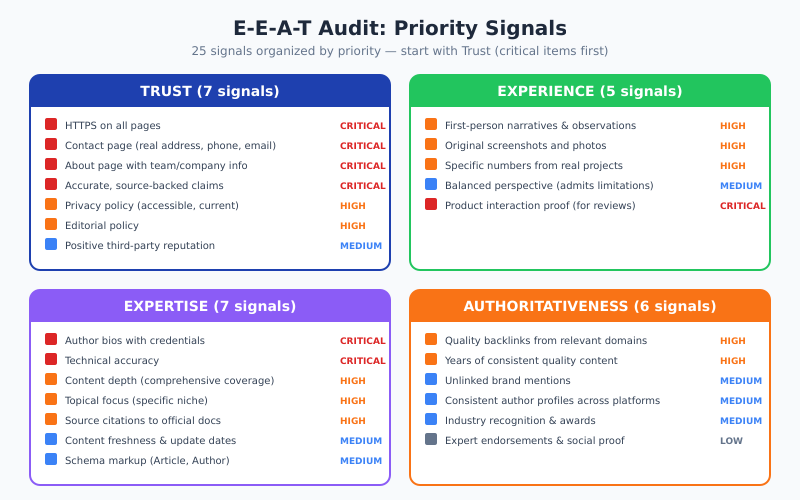
The E-E-A-T Audit: 25 Signals to Check
Use this checklist to audit your site’s E-E-A-T signals. I’ve organized them by component and priority level.
Trust Signals (Check First)
| # | Signal | What to Check | Priority |
|---|---|---|---|
| 1 | HTTPS | Valid SSL certificate on all pages | Critical |
| 2 | Contact page | Real address, phone, email — not just a form | Critical |
| 3 | About page | Company/author background, mission, team info | Critical |
| 4 | Privacy policy | Clear, up-to-date, accessible from every page | High |
| 5 | Editorial policy | How content is created, reviewed and updated | High |
| 6 | Accurate information | Claims backed by sources, no misleading content | Critical |
| 7 | User reviews/reputation | Positive reputation on third-party review sites | Medium |
Experience Signals
| # | Signal | What to Check | Priority |
|---|---|---|---|
| 8 | First-person narratives | Authors share personal experiences and observations | High |
| 9 | Original media | Own screenshots, photos, videos — not stock images | High |
| 10 | Specific details | Concrete numbers, timelines and contexts from real projects | High |
| 11 | Balanced perspective | Acknowledges limitations, failures and edge cases | Medium |
| 12 | Product interaction proof | Evidence of actually using products reviewed | Critical (reviews) |
Expertise Signals
| # | Signal | What to Check | Priority |
|---|---|---|---|
| 13 | Author bios | Relevant credentials, linked to author pages | Critical |
| 14 | Content depth | Comprehensive coverage beyond surface level | High |
| 15 | Technical accuracy | Correct terminology, current information, proper citations | Critical |
| 16 | Topical focus | Site covers a specific niche deeply, not everything shallowly | High |
| 17 | Content freshness | Regular updates with visible “last updated” dates | Medium |
| 18 | Source citations | Links to official docs, studies and primary sources | High |
| 19 | Schema markup | Article, Author and Organization schema implemented | Medium |
Authoritativeness Signals
| # | Signal | What to Check | Priority |
|---|---|---|---|
| 20 | Quality backlinks | Links from respected, relevant domains | High |
| 21 | Brand mentions | Unlinked mentions on authoritative sites | Medium |
| 22 | Author presence | Consistent author profiles across platforms | Medium |
| 23 | Publishing history | Years of consistent quality content | High |
| 24 | Industry recognition | Awards, speaking engagements, quoted in media | Medium |
| 25 | Social proof | Expert endorsements, community engagement | Low |
E-E-A-T for YMYL vs Non-YMYL Content
Not all content faces the same E-E-A-T scrutiny. Google applies stricter standards to YMYL (Your Money or Your Life) topics — content that could impact someone’s health, finances, safety or well-being.
| Category | YMYL Level | E-E-A-T Standard | Examples |
|---|---|---|---|
| Medical/health | High YMYL | Requires professional credentials | Treatment guides, symptom pages, drug info |
| Financial | High YMYL | Requires certified expertise | Investment advice, tax guidance, insurance |
| Legal | High YMYL | Requires legal professional review | Legal guides, rights information |
| News/current events | Medium YMYL | Requires editorial standards | Political news, safety alerts |
| Product reviews | Medium YMYL | Requires hands-on experience | Electronics, supplements, software |
| SEO/marketing | Low YMYL | Expertise and experience valued | SEO guides, analytics tutorials |
| Entertainment | Low YMYL | Basic quality standards | Movie reviews, hobby content |
For SEO and digital marketing content — the topics we cover on this site — E-E-A-T standards are moderate. Formal credentials aren’t required, but demonstrated expertise through detailed, accurate content and genuine experience with the tools and strategies you write about is essential.
E-E-A-T and AI Search
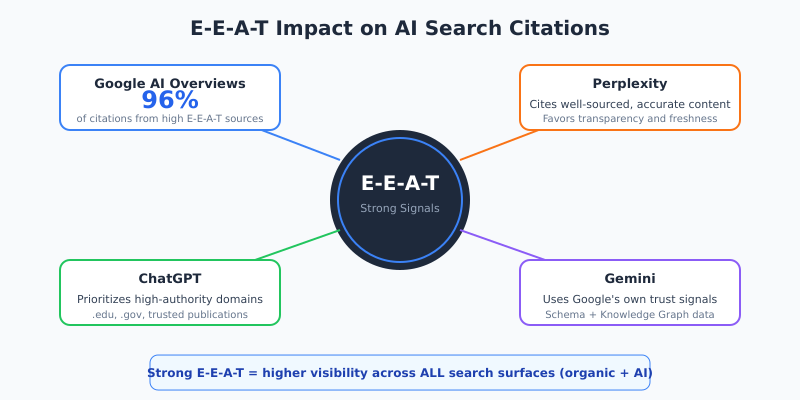
E-E-A-T has become even more important with the rise of AI search. Data shows that 96% of Google AI Overview citations come from sources with strong E-E-A-T signals. Similarly, ChatGPT and Perplexity weight authoritative, well-structured content from recognized sources when selecting citations.
This creates a virtuous cycle. Strong E-E-A-T signals improve both traditional rankings and AI search visibility. The same content qualities that make Google’s quality raters rate your page highly are the qualities that make AI models cite your content.
Therefore, investing in E-E-A-T isn’t just about traditional SEO anymore. It’s about visibility across every search surface — organic results, AI Overviews, ChatGPT citations and Perplexity answers.
Common E-E-A-T Mistakes
Based on dozens of E-E-A-T audits, these mistakes appear again and again:
- No author bios — content published without any attribution. Readers and algorithms can’t evaluate expertise without knowing who wrote it.
- Generic stock photos everywhere — signals zero first-hand experience. One original screenshot is worth twenty stock images.
- Missing contact information — a contact form alone isn’t enough. Include a physical address, phone number and real email address.
- Covering too many topics — a site about SEO, cooking, fitness and cryptocurrency has no topical authority in any of them.
- No external citations — making claims without linking to supporting evidence. Always cite official documentation and research. See our on-page SEO guide for proper citation practices.
- Outdated content — publishing a “2024 guide” in 2026 without updating it destroys trust. Add visible update dates and review content regularly.
- Ignoring negative reputation signals — unresolved complaints, poor BBB ratings or negative press undermine trust even if on-site signals are strong.
Bottom Line
E-E-A-T isn’t a checkbox exercise. It’s a framework for building the kind of content and digital presence that deserves to rank. Focus on trust first — it’s the foundation everything else builds on. Then demonstrate genuine experience, deepen your expertise through comprehensive content, and build authoritativeness by creating work that others want to reference.
The sites that treat E-E-A-T as an ongoing practice rather than a one-time optimization will have a compounding advantage. Every quality article, every original data point, every citation from an authoritative source adds to your E-E-A-T profile. And in an era where AI search amplifies trustworthy sources, that advantage grows faster than ever.
Start with the 25-signal audit above. Fix the critical items first. Then build a systematic approach to strengthening each component over time. E-E-A-T isn’t about perfection — it’s about consistent, genuine quality signals that Google’s algorithms are increasingly equipped to recognize.
