Link Building Guide: 7 White Hat Strategies That Work
Link building remains the most challenging and impactful aspect of SEO in 2026. While Google’s algorithm considers hundreds of ranking factors, backlinks from authoritative sites continue to signal trust and relevance in ways that on-page optimization alone cannot achieve. The difference between sites that rank on page one and those buried on page three often comes down to link profile quality.
This guide covers proven link building strategies that work within Google’s guidelines — approaches that build sustainable authority rather than risking penalties. With Google’s SpamBrain AI detecting manipulative tactics more aggressively than ever, white hat methods aren’t just safer; they’re more effective long-term.
Why Links Still Matter
Google’s original PageRank algorithm treated links as votes of confidence — a concept that remains foundational despite algorithm evolution. When authoritative sites link to your content, they transfer trust signals that help search engines evaluate your site’s credibility and relevance.
Links influence rankings through several mechanisms:
- Authority transfer — Links from high-authority domains pass ranking power to your pages
- Relevance signals — Links from topically related sites strengthen your topical authority
- Discovery — Search engine crawlers find new content by following links
- Trust indicators — Editorial links from reputable sources signal content quality
The key distinction in 2026: quality dramatically outweighs quantity. One link from a respected industry publication delivers more value than dozens of links from low-quality directories or blog networks.
What Makes a Quality Backlink
Before pursuing links, understand what separates valuable backlinks from worthless or harmful ones.
Domain Authority
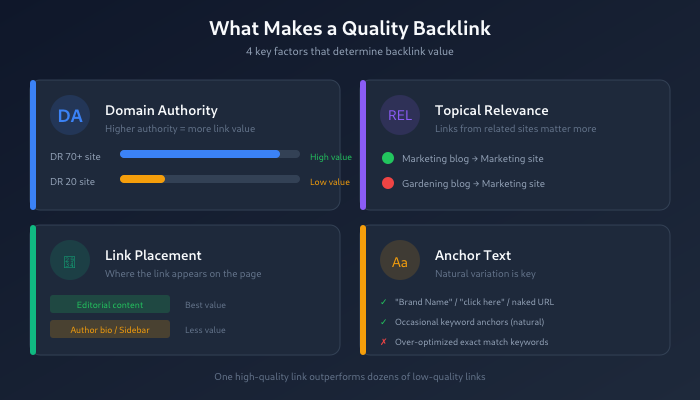
Links from established, authoritative domains carry more weight. Check Domain Rating (Ahrefs) or Domain Authority (Moz) as rough proxies, but remember these are third-party metrics — not Google’s actual assessment. A DR 70 site linking to you transfers more authority than a DR 20 site, but context matters more than numbers alone.
Topical Relevance
Links from sites in your industry or niche carry stronger relevance signals than links from unrelated sites. A marketing agency benefits more from a link on a marketing blog than from a gardening website, even if the gardening site has higher domain authority. Google understands topical relationships — pursue links that make contextual sense.
Link Placement
Editorial links within main content pass more value than footer links, sidebar links, or author bio links. A contextual mention that naturally references your content as a resource carries the strongest signal. Links buried in footers or widget areas suggest paid or manipulative placement.
Anchor Text
The clickable text of a link provides relevance context. Natural anchor text varies — branded mentions, naked URLs, generic phrases (“click here”), and occasionally keyword-rich text. Over-optimized anchor text profiles (too many exact-match keyword anchors) trigger spam filters. Let anchors occur naturally rather than forcing keyword placement.
Strategy 1: Create Linkable Assets
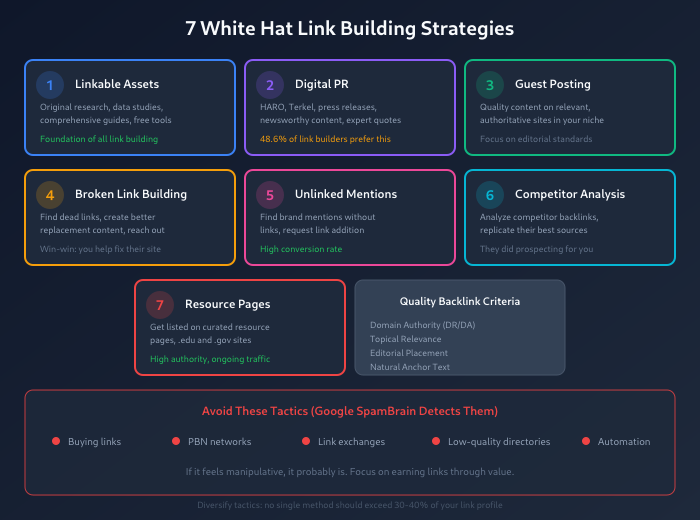
The foundation of sustainable link building is content worth linking to. Linkable assets attract backlinks naturally because they provide unique value that other content creators want to reference.
Original Research and Data
Publishing original research creates citation opportunities. When you’re the primary source for statistics or findings, every article discussing that topic potentially links back to you. Survey your audience, analyze your own data, or compile industry statistics into comprehensive reports.
Effective research formats include:
- Industry surveys and benchmark reports
- Data analysis from your own platform or tools
- Trend reports based on aggregated public data
- Case studies with measurable results
Comprehensive Guides
In-depth guides that thoroughly cover a topic become reference resources. When someone writes about a subtopic, they often link to comprehensive guides for readers wanting deeper information. The “Skyscraper Technique” — creating content significantly better than existing top results — generates links by becoming the definitive resource on a topic. Use keyword research to identify topics where comprehensive coverage is lacking.
Tools and Calculators
Free tools attract links continuously without ongoing promotion. A mortgage calculator, ROI estimator, or industry-specific tool provides lasting utility that bloggers and journalists reference. The initial development investment pays dividends through sustained link acquisition.
Visual Assets
Infographics, charts, and diagrams get embedded and linked when they effectively communicate complex information. Create visuals that others will want to include in their content — data visualizations, process diagrams, or comparison charts that save readers time understanding concepts.
Strategy 2: Digital PR
Digital PR has emerged as the leading link building approach in 2026, with nearly 50% of link builders favoring it over other strategies. This method earns links through media coverage rather than direct outreach to website owners.
Newsworthy Content
Create content that journalists want to cover. This typically means data-driven stories, contrarian takes on trending topics, or research revealing surprising findings. Think like a journalist: what would make a compelling headline? What data would support an interesting story?
HARO and Expert Platforms
Platforms like HARO (Help a Reporter Out), Terkel, and Qwoted connect sources with journalists. Reporters post queries seeking expert quotes; you respond with insights. When your contribution gets published, you typically receive a backlink. This approach builds links from high-authority news sites and industry publications.
Success requires:
- Fast response times — journalists work on deadlines
- Genuine expertise — generic responses get ignored
- Concise, quotable answers — make the journalist’s job easy
- Relevant credentials — your background should match the topic (consider author schema on your site)
Press Release Distribution
For genuinely newsworthy announcements — product launches, funding rounds, major partnerships — press releases can generate coverage and links. The key word is “newsworthy.” Routine updates don’t warrant press releases and won’t attract coverage. Reserve this tactic for significant company milestones.
Strategy 3: Guest Posting
Guest posting remains effective when approached correctly. The goal isn’t volume — it’s placing quality content on relevant, authoritative sites that reach your target audience.
Finding Opportunities
Target sites that:
- Cover topics relevant to your expertise
- Have engaged audiences (comments, shares)
- Maintain editorial standards (not accepting any submission)
- Include author bios with links
Search operators help identify prospects: “write for us” + [your industry], “guest post guidelines” + [topic], “contribute” + [niche]. Competitor backlink analysis also reveals sites accepting guest content in your space.
Pitching Effectively
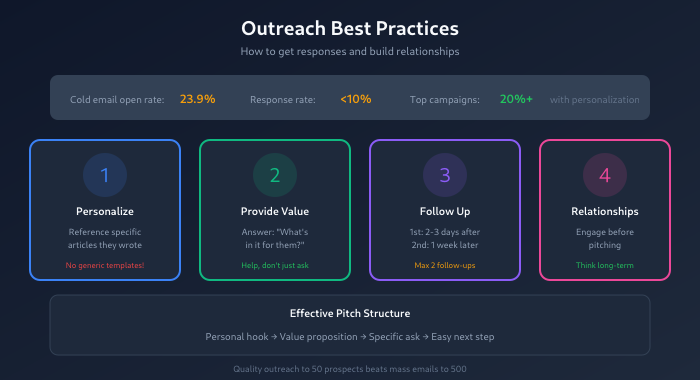
Generic pitches fail. Only 23.9% of cold emails get opened, and response rates under 10% are common. Effective pitches demonstrate familiarity with the target site and offer genuine value.
Elements of a successful pitch:
- Personalization — Reference specific articles you’ve read on their site
- Relevant topic ideas — Propose subjects that fit their content gaps
- Writing samples — Link to your best published work
- Brief credentials — Establish why you’re qualified to write on this topic
Avoid mass-blast templates. Experienced editors recognize automated outreach immediately. Quality over quantity applies to pitching as much as to link building itself.
Strategy 4: Broken Link Building
Broken link building offers value to website owners while acquiring links. The process: find pages with broken outbound links, create content that could replace the dead resource, then reach out offering your content as a working alternative.
Finding Broken Links
Tools like Ahrefs’ Content Explorer or Check My Links (Chrome extension) identify pages with broken links. Focus on resource pages and comprehensive guides in your niche — these typically contain many outbound links, increasing the chance of finding broken ones.
Creating Replacement Content
Your replacement content must genuinely serve as a substitute for the dead resource. If the broken link pointed to a statistics page, create a better statistics page. If it linked to a how-to guide, create a more comprehensive guide. The content should be at least as good as — ideally better than — what originally existed.
Outreach Approach
Frame your outreach as helpful rather than self-serving. You’re alerting someone to a problem on their site and offering a solution. Keep emails concise: identify the broken link, explain why it matters (poor user experience, SEO impact), and suggest your content as a replacement.
Strategy 5: Unlinked Brand Mentions
When your brand, product, or team members get mentioned online without a link, you have a conversion opportunity with high success rates. The content already exists and already references you — you’re simply requesting the addition of a link.
Finding Mentions
Set up Google Alerts for your brand name, product names, and key personnel. Tools like Mention, Brand24, or Ahrefs’ Content Explorer also track brand mentions. Regularly review new mentions and identify those without links.
Conversion Outreach
Outreach for unlinked mentions converts at higher rates than cold link requests because you’re not asking for a favor — you’re asking them to properly credit an existing reference. A brief, friendly email thanking them for the mention and requesting a link typically suffices.
Strategy 6: Competitor Backlink Analysis
Your competitors have already done link prospecting work for you. Analyzing their backlink profiles reveals sites that link to content in your space — and might link to yours.
Analysis Process
Using Ahrefs, SEMrush, or Moz, export your competitors’ backlink profiles. Filter for:
- Links from high-authority domains
- Editorial links (not directories or forums)
- Links to content similar to yours
- Recently acquired links (indicating active sites)
Replication Strategies
For each viable link, determine the acquisition method. Did your competitor guest post? Get interviewed? Provide a quote? Appear on a resource page? Understanding how they earned the link reveals how you might earn a similar one. Create better content, reach out with a compelling angle, or offer something the competitor didn’t.
Strategy 7: Resource Page Link Building
Resource pages curate links to helpful content on specific topics. Getting included means ongoing traffic and link equity from a page designed to send visitors to valuable resources.
Finding Resource Pages
Search operators identify resource pages: “resources” + [topic], “helpful links” + [industry], “recommended reading” + [niche], intitle:”resources” + [keyword]. Educational institutions (.edu) and government sites (.gov) often maintain resource pages with high authority value.
Getting Included
Resource page managers want to provide value to their visitors. Your outreach should demonstrate how your content benefits their audience. Highlight what makes your resource unique or comprehensive. If the page hasn’t been updated recently, mention that you noticed and offer your fresh resource as an addition.
Outreach Best Practices
Most link building strategies require outreach. These principles improve response rates across all approaches.
Personalization Is Non-Negotiable
Generic templates get deleted. Personalization proves you’ve actually visited their site and understand their content. Reference a specific article, mention something unique about their approach, or connect your pitch to their recent work. Even with AI tools assisting research, genuine personalization requires human judgment.
Provide Clear Value
Every outreach email should answer: “What’s in it for them?” Whether you’re offering content, alerting them to broken links, or suggesting a resource addition, the benefit to the recipient should be obvious. Self-serving requests without value exchange rarely succeed.
Follow Up Strategically
Reply rates drop significantly after the first email, but follow-ups still convert. Send one follow-up 2-3 days after your initial email. If still no response, a second follow-up a week later can work. Beyond that, move on — persistence becomes annoyance.
Build Relationships
The best link builders think long-term. Engage with prospects on social media before pitching. Comment thoughtfully on their content. Share their work. When you eventually reach out, you’re not a stranger asking for a favor — you’re a familiar name offering collaboration.
What to Avoid
Google’s SpamBrain AI has become remarkably effective at detecting manipulative link building. These tactics risk penalties:
- Buying links — Paid links violate Google’s guidelines and get detected
- Private Blog Networks (PBNs) — Google identifies and devalues PBN links
- Link exchanges — Reciprocal linking schemes are easily spotted
- Low-quality directories — Mass directory submissions provide no value
- Automated link building — Software-generated links are spam
- Comment spam — Links in blog comments are typically nofollow and worthless
If a tactic feels manipulative, it probably is. When in doubt, ask: “Would I pursue this link if search engines didn’t exist?” If the answer is no, the link isn’t worth pursuing.
Measuring Link Building Success
Track these metrics to evaluate your link building efforts:
- New referring domains — Unique domains linking to you (more important than total backlinks)
- Domain authority growth — Third-party authority metrics trending upward
- Organic traffic — The ultimate measure of SEO success (track via GA4)
- Keyword rankings — Position improvements for target keywords
- Referral traffic — Visitors arriving through your backlinks
Link building is a long-term investment. Expect 3-6 months before seeing significant ranking improvements from new links. Patience and consistency matter more than short-term tactics.
Bottom Line
Effective link building in 2026 requires creating genuine value and building real relationships. The shortcuts that worked a decade ago now trigger penalties. Focus on content worth linking to, pursue opportunities where you can provide value, and think of outreach as relationship building rather than transaction hunting.
Start with linkable asset creation — without quality content, no link building strategy succeeds long-term. Then diversify across digital PR, guest posting, broken link building, and competitor analysis. No single tactic should dominate more than 30-40% of your link profile. The sites that rank consistently build diverse, natural-looking backlink profiles through multiple legitimate channels. Make sure your technical SEO is solid so search engines can properly credit your link equity.