Keyword Research Guide: Search Intent, Topic Clusters and AI Optimization
Keyword research in 2026 looks nothing like it did even two years ago. The rise of AI search engines, voice assistants, and Google’s AI Overviews has fundamentally changed how people find information — and how we need to approach keyword strategy. Traditional volume-chasing and keyword stuffing are not just ineffective; they’re counterproductive.
Modern keyword research requires understanding search intent, building topic clusters, and optimizing for both traditional search engines and AI platforms like ChatGPT, Perplexity, and Claude. This guide covers the complete methodology for finding and prioritizing keywords that drive traffic and conversions in 2026.
Why Keyword Research Has Changed
Three major shifts have transformed keyword research from a volume game to an intent game.
AI Search Engines
Users increasingly get answers directly from AI assistants rather than clicking through to websites. When someone asks ChatGPT or Perplexity a question, the AI synthesizes information from multiple sources and delivers a direct answer. To capture this traffic, your content needs to be authoritative enough that AI systems cite you as a source — not just rank for a keyword.
Google AI Overviews
Google’s AI Overviews now appear for many informational queries, providing summarized answers at the top of search results. Traditional position one rankings matter less when an AI-generated summary answers the query before users see organic results. Keyword strategy must now account for AI Overview optimization alongside traditional ranking.
Conversational Search
Voice search and AI chatbots have shifted queries from fragmented keywords to natural language questions. People don’t search “best laptop 2026” — they ask “what’s the best laptop for video editing under $1500?” Long-tail, conversational queries now represent the majority of search volume, requiring content that answers specific questions rather than targeting broad terms.
Understanding Search Intent
Search intent — the underlying goal behind a query — determines what content Google shows. Mismatching intent guarantees failure regardless of how well you optimize. Before targeting any keyword, identify which of these four intent types it represents.
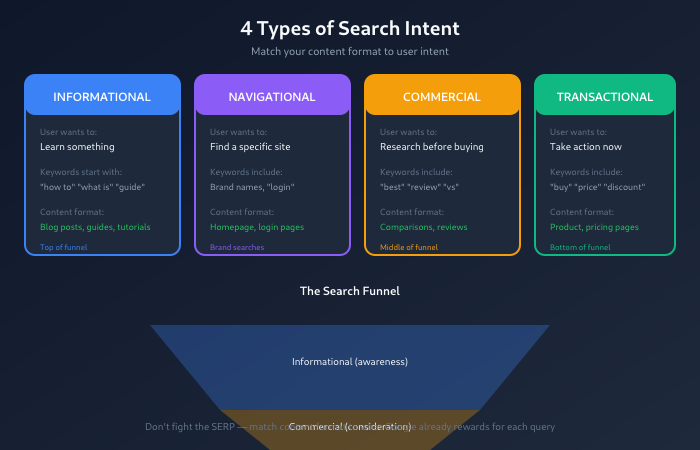
Informational Intent
Users want to learn something. These queries typically start with “what is,” “how to,” “why does,” or “guide to.” The searcher isn’t ready to buy — they’re gathering information.
Examples: “how to start a podcast,” “what is compound interest,” “why do cats purr”
Content format: Blog posts, guides, tutorials, explainer videos
Navigational Intent
Users want to reach a specific website or page. They already know where they want to go and use search as a navigation shortcut.
Examples: “Gmail login,” “Spotify download,” “Amazon customer service”
Content format: Homepage, login pages, brand-specific landing pages
Commercial Intent
Users are researching before a purchase. They’re comparing options, reading reviews, and evaluating alternatives. They have buying intent but aren’t ready to convert yet.
Examples: “best CRM software,” “iPhone vs Samsung,” “Mailchimp alternatives,” “Notion review”
Content format: Comparison posts, reviews, “best of” lists, buying guides
Transactional Intent
Users are ready to take action — purchase, sign up, download, or subscribe. These high-value queries indicate immediate conversion potential.
Examples: “buy MacBook Pro,” “Semrush pricing,” “free project management template,” “hire SEO consultant”
Content format: Product pages, pricing pages, signup flows, service pages
Keyword Research Process
Follow this systematic approach to build a keyword strategy that drives results.
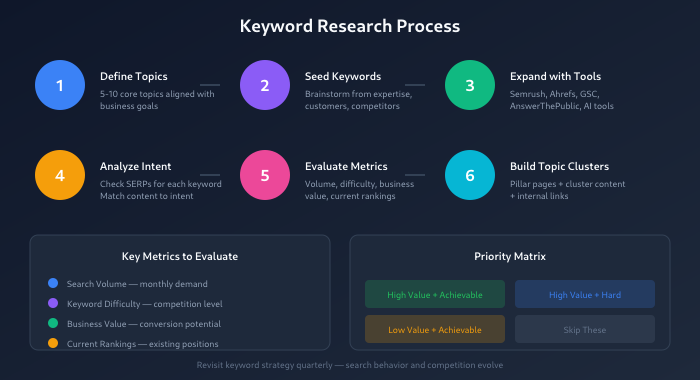
Step 1: Define Your Topics
Start with topics, not keywords. What subjects does your business need to own? What questions do your customers ask? What problems do you solve?
List 5-10 core topics that align with your business goals. For a project management software company, topics might include: project planning, team collaboration, task management, resource allocation, and agile methodology.
Step 2: Generate Seed Keywords
For each topic, brainstorm seed keywords — the obvious terms someone might search. Don’t worry about search volume yet; focus on relevance.
Sources for seed keywords:
- Your own expertise — what terms do you use?
- Customer conversations — how do they describe their problems?
- Competitor websites — what terms do they target?
- Industry forums and communities — what questions get asked?
- Sales team input — what objections and questions come up?
Step 3: Expand with Tools
Use keyword research tools to expand your seed list into comprehensive keyword opportunities.
Essential tools:
- Semrush — comprehensive keyword data with intent classification
- Ahrefs — excellent for competitor keyword analysis
- Google Search Console — free data on queries you already rank for (combine with GA4 tracking for conversion insights)
- AnswerThePublic — question-based keyword ideas
- Google autocomplete — real-time search suggestions
- People Also Ask — related questions from Google SERPs
AI tools like ChatGPT and Claude can also generate keyword ideas when prompted effectively. Ask them to list questions your target audience might ask about a topic, or to suggest related subtopics you might have missed.
Step 4: Analyze Search Intent
For each keyword, determine the dominant search intent by examining the current SERP. Google the keyword and study what ranks:
- All guides and how-to articles? → Informational intent
- Product pages and e-commerce listings? → Transactional intent
- Comparison posts and reviews? → Commercial intent
- Brand homepages? → Navigational intent
Don’t fight the SERP. If Google shows product pages for a keyword and you create a blog post, you won’t rank — regardless of content quality. Match your content format to what Google already rewards for that query.
Step 5: Evaluate Keyword Metrics
Analyze each keyword opportunity across multiple dimensions:
Search volume: Monthly searches indicate demand. But don’t chase volume blindly — a 50-volume keyword with perfect intent often outperforms a 5,000-volume keyword with mismatched intent.
Keyword difficulty: How hard is it to rank? Tools estimate this based on competitor strength. New sites should target lower difficulty keywords initially.
Business value: Does this keyword attract your target customers? A keyword can have high volume but bring visitors who’ll never convert.
Current rankings: Are you already ranking somewhere for this term? Improving from position 15 to position 5 is easier than ranking from scratch.
Step 6: Build Topic Clusters
Group related keywords into topic clusters — collections of content around a central theme. Each cluster has:
- Pillar page: Comprehensive content covering the broad topic
- Cluster content: Specific articles addressing subtopics and long-tail queries
- Internal links: Connections between pillar and cluster pages — see on-page SEO guide for linking strategies
Topic clusters signal topical authority to Google. Rather than scattered articles on unrelated subjects, you demonstrate deep expertise in specific areas. This cluster approach has become essential for ranking in 2026’s competitive landscape.
Prioritizing Keywords
You’ll generate more keyword opportunities than you can possibly target. Prioritization determines success.
The Prioritization Matrix
Score keywords on two axes: business value (how important is this keyword to your goals?) and achievability (can you realistically rank for it?).
High value + High achievability: Priority targets. Start here.
High value + Low achievability: Long-term targets. Build authority first.
Low value + High achievability: Quick wins. Use for momentum.
Low value + Low achievability: Skip these entirely.
Intent-Based Prioritization
Consider the funnel stage each keyword represents:
- Transactional keywords drive immediate revenue but are highly competitive
- Commercial keywords capture users close to conversion decisions
- Informational keywords build audience and authority for long-term growth
A balanced strategy targets all three. Focusing only on transactional keywords limits your audience to ready-to-buy visitors — a tiny fraction of potential customers. Informational content captures users earlier in their journey and builds the authority needed to rank for competitive terms.
Optimizing for AI Search
Traditional keyword research targeted Google rankings. In 2026, you also need visibility in AI search engines and Google’s AI Overviews.
AI Citation Factors
AI systems cite sources based on different criteria than traditional search rankings:
- Authoritative sourcing: Clear author credentials, citations, and expertise signals
- Direct answers: Content that directly addresses specific questions
- Structured content: Clear headings, lists, and organized information that AI can parse — schema markup helps significantly
- Recency: Up-to-date information with clear publication dates
- Factual accuracy: Verifiable claims with supporting evidence
Question-Based Keywords
AI queries are predominantly questions. Prioritize keywords phrased as questions and structure content to answer them directly. Include the question in your heading, then provide a clear, concise answer in the first paragraph before elaborating.
Tools like AnswerThePublic and AlsoAsked surface question-based keywords. Google’s “People Also Ask” feature reveals related questions for any query. These represent exactly the questions AI systems need to answer.
Monitoring AI Visibility
Track whether your content gets cited by AI systems. Tools like Semrush’s AI Visibility Analytics and Ahrefs’ Brand Radar now monitor brand mentions across ChatGPT, Perplexity, Claude, and Google’s AI features. This data reveals which content AI systems consider authoritative — and where you’re missing opportunities.
Long-Tail Keyword Strategy
Long-tail keywords — longer, more specific phrases — deserve special attention in 2026.
Why Long-Tail Matters More
Voice search and AI chatbots have dramatically increased long-tail query volume. When someone speaks to an assistant, they use natural language: “what’s the best budget-friendly DSLR camera for beginners” rather than “best budget DSLR.”
Long-tail keywords also:
- Face less competition than head terms
- Signal clearer intent (easier to match content)
- Convert at higher rates (more specific = more qualified)
- Aggregate into significant traffic when targeted systematically
Finding Long-Tail Opportunities
Start with your seed keywords and expand using:
- Google autocomplete: Type your keyword and note suggestions
- Related searches: Check the bottom of Google results
- People Also Ask: Expand these boxes for question variations
- Forum mining: Search Reddit, Quora, and industry forums for how people phrase questions
- Search Console: Find long-tail queries you already get impressions for
Competitor Keyword Analysis
Your competitors have already done keyword research. Learn from their efforts.
Identifying Competitor Keywords
Use Ahrefs or Semrush to export keywords your competitors rank for. Filter for:
- Keywords where they rank in top 10 (validated opportunities)
- Keywords with decent volume that match your business
- Keywords where their content is weak (opportunity to outperform)
Content Gap Analysis
Identify keywords multiple competitors rank for that you don’t. These represent proven opportunities — if three competitors target a keyword, it clearly has business value. Run content gap analyses in Ahrefs or Semrush, comparing your domain against 3-4 competitors simultaneously.
Competitive Positioning
When targeting keywords competitors already own, you need a differentiation strategy. Options include:
- Depth: Create more comprehensive content
- Recency: Provide more current information
- Angle: Address the topic from a unique perspective
- Format: Offer a different content type (video vs text, interactive vs static)
- Authority: Include original research or expert insights
Common Keyword Research Mistakes
Avoid these frequent errors that undermine keyword strategies.
Chasing Volume Over Intent
High-volume keywords seem attractive but often bring unqualified traffic. A 10,000-volume keyword that attracts tire-kickers delivers less value than a 500-volume keyword that attracts buyers. Always evaluate business value alongside volume.
Ignoring SERP Reality
If the top 10 results are all from massive authority sites with thousands of backlinks, a new site won’t rank there regardless of content quality. You’ll need a solid link building strategy before targeting such keywords. Check who currently ranks before committing resources. Target keywords where you can realistically compete.
Keyword Stuffing
Repeating your target keyword unnaturally doesn’t help — it hurts. Google’s natural language processing understands semantic relationships. Write for humans, use synonyms and related terms naturally, and trust that Google will understand your topic.
One-and-Done Research
Keyword research isn’t a one-time project. Search behavior evolves, new terms emerge, and competitors change strategies. Revisit your keyword strategy quarterly, monitoring performance and identifying new opportunities — the same cadence that lets you catch pages losing traffic to content decay before the drop compounds.
Bottom Line
Keyword research in 2026 requires balancing traditional SEO fundamentals with new AI-focused considerations. Start with topics and user intent, not just search volume. Build topic clusters that demonstrate expertise. Target long-tail, conversational queries that match how people actually search. And optimize for AI citation alongside traditional rankings. Before targeting new keywords, ensure your technical SEO foundation is solid.
The tools have evolved, the search landscape has fragmented across multiple platforms, but the core principle remains: understand what your audience is looking for and create content that genuinely serves their needs. Keywords are signals pointing to those needs — follow them strategically, and organic growth follows.