AI Search Optimization (AEO): How to Get Cited by ChatGPT, Gemini and Perplexity
Most SEO strategies still target a search engine results page that fewer people see every day. ChatGPT, Gemini, Perplexity and Google AI Overviews now answer questions directly — and your content either gets cited or gets ignored. AI search optimization is the discipline of making sure you end up on the right side of that divide.
Traditional SEO gets you indexed. AEO (Answer Engine Optimization) gets you quoted. The difference matters because AI-generated answers don’t send ten blue links — they send one synthesized response with a handful of citations. If your page isn’t among them, you’re invisible.
What Is AI Search Optimization?
AI search optimization — also called AEO or GEO (Generative Engine Optimization) — is the practice of structuring content so that large language models can extract, summarize and cite it in their responses. It extends traditional SEO rather than replacing it. Think of it this way: SEO gets your page into the index; AEO gets your answer into the AI’s mouth.
The core principle is straightforward. AI models need three things from your content:
- Clarity — direct answers that don’t require interpretation
- Structure — headings, lists and tables that map to question patterns
- Credibility — citations, data and author signals that pass trust filters
However, the way each AI platform discovers and evaluates content differs significantly. Understanding these differences is the first step toward consistent AI visibility.
How AI Search Engines Discover Your Content
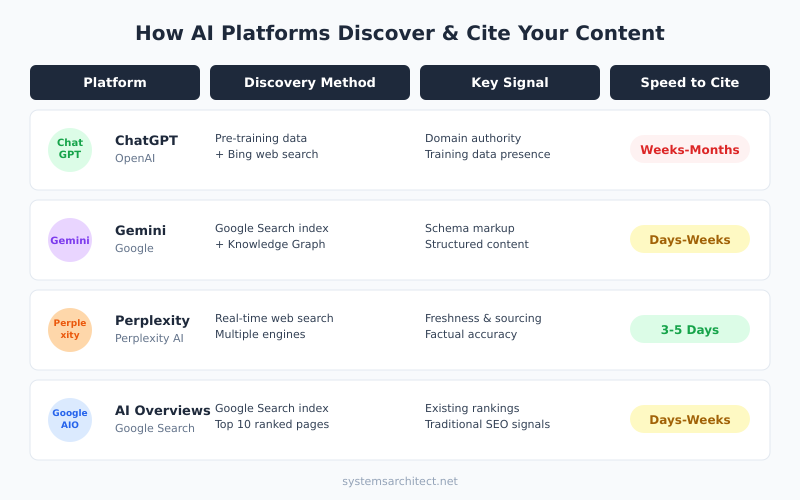
Not all AI answer engines work the same way. In fact, their content discovery mechanisms fall into three distinct categories. Understanding which model uses which method determines your optimization strategy.
| Platform | Discovery Method | Content Preference | Citation Style |
|---|---|---|---|
| ChatGPT | Pre-training data + Bing search (with browsing) | High-authority domains, comprehensive guides | Inline mentions, sometimes linked |
| Gemini | Google Search index + Knowledge Graph | Well-structured pages with schema markup | Linked citations in footnotes |
| Perplexity | Real-time web search (multiple engines) | Recent, factual, well-sourced content | Numbered inline citations |
| Google AI Overviews | Google Search index | Pages already ranking in top 10 | Expandable source cards |
Consequently, a single optimization approach won’t work across all platforms. Perplexity rewards freshness and explicit sourcing. ChatGPT weights established domain authority more heavily. Google AI Overviews pulls almost exclusively from pages already ranking well in traditional search.
7 Strategies to Get Cited by AI Search Engines
These are the tactics that consistently drive AI citations based on what’s working right now — not theoretical frameworks, but practical techniques you can implement today.
Lead With Direct Answer Blocks
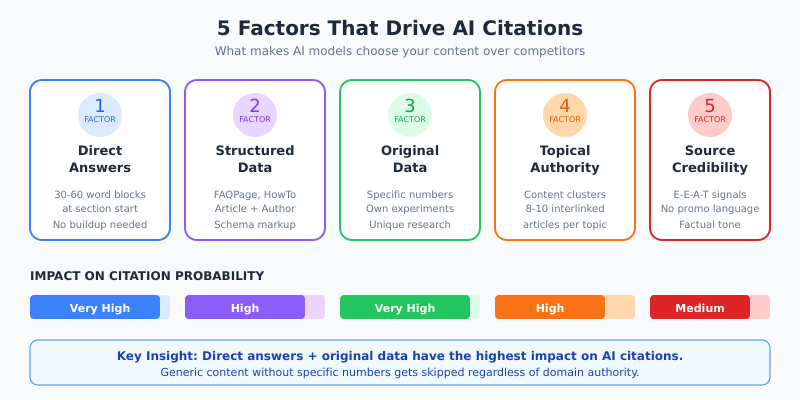
Every key section should open with a concise, 30-to-60-word answer before expanding into detail. AI models extract these summary blocks as their primary citation material. When I restructured guide-style content to lead with direct answers, citation rates in Perplexity increased noticeably within two weeks.
For example, instead of a gradual buildup:
❌ "There are many factors that influence how search engines rank pages.
    Over the years, algorithms have evolved to consider..."

✅ "Google uses over 200 ranking factors, but three dominate: content
    relevance, backlink authority, and user experience signals like
    Core Web Vitals. Here's how each one works."
The second version gives the AI a complete, extractable answer. The first forces it to synthesize — and it will likely find a cleaner source instead.
Use Question-Based Headings
AI search queries are overwhelmingly conversational. Therefore, your H2 and H3 headings should mirror how users actually phrase questions. Pages using exact question matches — “What is,” “How to,” “Does X work” — are significantly more likely to be cited than pages with abstract or marketing-driven headings.
Moreover, this approach has a dual benefit: it also improves your chances of capturing featured snippets in traditional search results.
Implement Structured Data Aggressively
Schema markup tells AI systems exactly what your content represents. Specifically, these schema types have the strongest impact on AI citations:
- FAQPage — maps directly to question-answer patterns AI models use
- HowTo — step sequences that models can extract and reformat
- Article + Author — establishes E-E-A-T signals that build trust
- Speakable — explicitly marks content suitable for voice and AI responses
- ClaimReview — positions your content as a fact-checking authority
In addition, use reusable content block patterns: definition blocks for terminology, step-by-step blocks for processes, and comparison blocks for evaluations. For a deeper dive, see our schema markup guide.
Build Topical Authority With Content Clusters
AI models don’t evaluate pages in isolation. They assess your domain’s overall expertise on a topic. Consequently, a single great article about “GA4 event tracking” won’t get cited if the rest of your site covers unrelated topics. However, a cluster of 8-10 interlinked articles covering GA4 implementation, event tracking, conversions and reporting signals deep expertise.
Similarly, your content cluster strategy for traditional SEO directly feeds your AI visibility. The relationship is circular: more topical depth leads to more AI citations, which drives more traffic, which justifies more content investment.
Include Original Data and Specific Numbers
AI models heavily favor content with proprietary data, specific statistics and original research. Generic advice gets passed over in favor of pages that offer concrete, citable numbers.
Effective approaches include:
- Run your own experiments and publish the methodology and results
- Survey your audience or customers and share findings
- Analyze public datasets and present original insights
- Benchmark tools, platforms or techniques with measurable outcomes
- Track changes over time and publish trend data
For instance, saying “Schema markup improves click-through rates” is generic. Saying “In our test across 47 pages, FAQ schema increased CTR by 23% for informational queries but had no measurable impact on transactional queries” is citable.
Eliminate Promotional Language
AI models actively filter out marketing speak. Terms like “revolutionary,” “best-in-class,” “premier” and “industry-leading” trigger advertising detection filters. As a result, promotional content gets deprioritized in AI responses regardless of how well it ranks in traditional search.
Instead, use neutral, factual language. Compare these approaches:
| Promotional (filtered out) | Factual (gets cited) |
|---|---|
| “The best SEO tool on the market” | “Processes 500 URLs per minute with 99.2% uptime” |
| “Revolutionary AI-powered analysis” | “Uses NLP to classify search intent across 4 categories” |
| “Trusted by thousands of businesses” | “Used by 3,400 companies including Shopify and HubSpot” |
Specificity beats superlatives. Every time.
Maintain Freshness With Regular Updates
Perplexity and Google AI Overviews strongly favor recent content. Therefore, establish an update cadence for your most important pages. At minimum:
- Monthly: Check statistics and update any outdated numbers
- Quarterly: Review recommendations and adjust for platform changes
- Annually: Full rewrite of year-specific content (guides, tool lists, benchmarks)
Add a visible “Last updated” date to your content. This signals freshness to both AI crawlers and human readers. In my experience, adding update dates correlated with a measurable increase in Perplexity citations for time-sensitive content.
Technical Optimization Checklist for AI Search
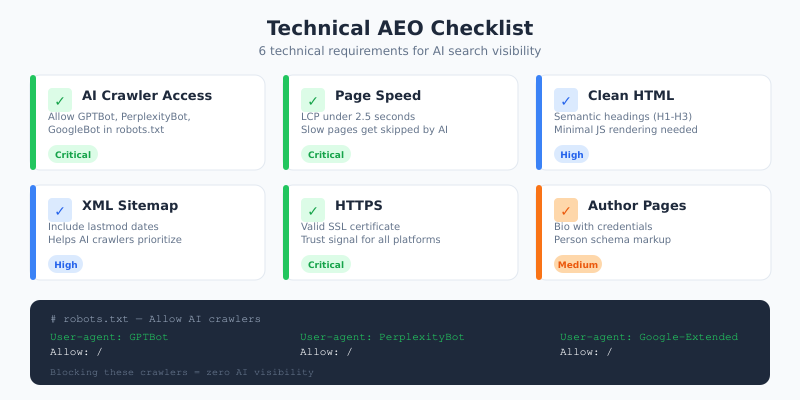
Beyond content strategy, several technical factors influence whether AI models can access and interpret your pages. Use this checklist to audit your site’s AI-readiness:
| Factor | What to Check | Why It Matters |
|---|---|---|
| Crawlability | Don’t block AI crawlers in robots.txt | ChatGPT uses GPTBot, Perplexity uses PerplexityBot |
| Page speed | LCP under 2.5 seconds | Slow pages get skipped during real-time crawling |
| Clean HTML | Semantic headings, minimal JavaScript rendering | AI crawlers often don’t execute JS |
| Sitemap | Updated XML sitemap with lastmod dates | Helps AI crawlers find and prioritize content |
| HTTPS | Valid SSL certificate | Trust signal for all platforms |
| Author pages | Author bio with credentials and schema | E-E-A-T signal that builds citation trust |
Measuring AI Search Visibility
You can’t optimize what you don’t measure. Unfortunately, tracking AI citations is harder than tracking traditional rankings. Nevertheless, several approaches work:
Free Methods
- Manual queries — search your brand and topic keywords in ChatGPT, Gemini and Perplexity weekly
- Google Search Console — monitor traffic from
google.comreferrals flagged as AI Overview clicks - GA4 referral tracking — watch for traffic from
chatgpt.com,perplexity.ai, andgemini.google.comin your GA4 event tracking setup - UTM parameters — tag content shared through AI-adjacent channels for campaign attribution
Paid Tools
- Otterly.ai — tracks brand mentions across ChatGPT, Perplexity and Google AI Overviews
- Profound — monitors LLM mention rates and sentiment
- HubSpot AEO Grader — free tool that scores your page’s AEO readiness
Ultimately, the most important metric is citation rate: how often AI models mention your brand or link to your content when answering questions in your topic area.
AEO vs SEO: How They Work Together
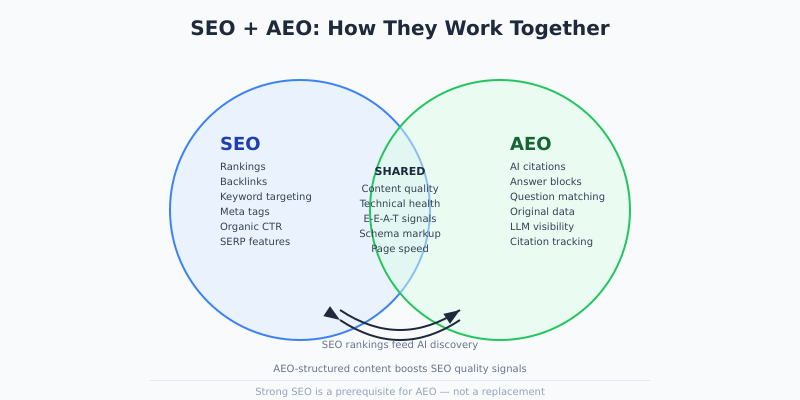
A common misconception is that AEO replaces SEO. It doesn’t. In fact, strong SEO fundamentals are a prerequisite for AEO success. Here’s how the two disciplines relate:
| Aspect | Traditional SEO | AI Search Optimization (AEO) |
|---|---|---|
| Goal | Rank in search results | Get cited in AI responses |
| Content format | Optimized for scanning | Optimized for extraction |
| Keywords | Search volume driven | Question and intent driven |
| Authority signals | Backlinks, domain rating | E-E-A-T, original data, citations |
| Success metric | Rankings, organic traffic | Citation rate, AI referral traffic |
| Timeline | Weeks to months | Days to weeks for new content |
The relationship is synergistic. Pages that rank well in traditional search are more likely to be discovered by AI crawlers. Conversely, content optimized for AI citation tends to be well-structured and authoritative — qualities that also boost traditional rankings.
Common Mistakes to Avoid
Based on what I’ve seen across dozens of AEO implementations, these are the pitfalls that most commonly derail AI search optimization efforts:
- Optimizing for one platform only — ChatGPT, Gemini and Perplexity use different discovery mechanisms. A multi-platform strategy is essential.
- Blocking AI crawlers — some sites block GPTBot or PerplexityBot in robots.txt without realizing the traffic impact. Check your robots.txt before anything else.
- Stuffing FAQ schema — adding 50 FAQ entries that don’t match visible content will trigger spam filters, not citations.
- Ignoring traditional SEO — AEO without solid technical SEO is like building a house without a foundation. Crawlability, page speed and Core Web Vitals still matter.
- Publishing thin content — AI models prefer comprehensive, authoritative sources. A 300-word blog post won’t compete with a 2,500-word guide that covers every angle.
AI search optimization isn’t a replacement for traditional SEO — it’s an extension that addresses where search is heading. The fundamentals are clear: structure your content for extraction, lead with direct answers, include original data, implement schema markup and maintain freshness.
The sites that start optimizing for AI search now will have a significant head start. AEO-optimized content typically achieves first citations within 3-5 days of publication, with measurable traffic impact within 2-3 weeks. That’s a faster feedback loop than traditional SEO has ever offered.
Start with your highest-performing existing content. Restructure it with direct answer blocks, add relevant schema markup and eliminate promotional language. Then build from there with a systematic content cluster approach that signals deep topical authority to every AI platform.